Three months with WHOOP MG 5.0, Oura 4, Polar365/Loop, Garmin Instinct 3, Helio strap
Date
Sep 9, 2025
Category
Technology
Hi folks,
I am back with a longer term comparison between the most popular no-screen wearables.
TL;DR
RHR trends align very well across brands.
HRV trends align well for Helio, Oura, WHOOP, Polar. Garmin HRV trend is the outlier in my data.
Sleep duration is consistently measured across all devices.
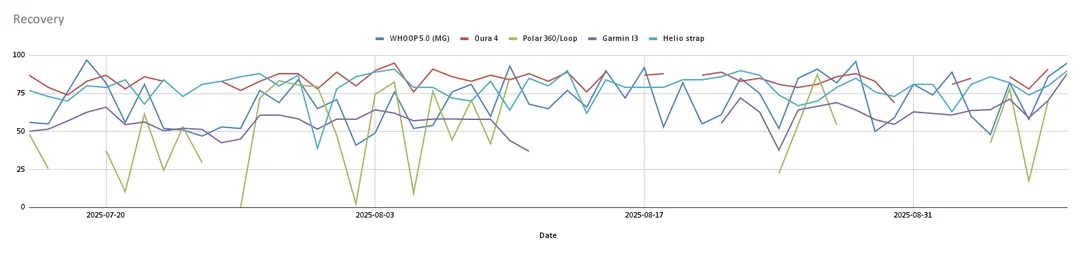
Recovery and readiness are not interchangeable across brands. Treat them as within-brand trends.
Context
I started wearing Helio on 15 July. The other devices had more history to learn my baseline, at least a month. WHOOP has three years of data on me. That matters when you compare anything that relies on personalized baselines.
How I compared
Correlation uses Spearman to capture trend agreement.
Recovery proxies:
for WHOOP it's plain simple Recovery,
Polar sleep duration is Deep + Light + REM as it does not give one simple number.
Oura RHR uses Avg Sleeping HR. Polar RHR uses Avg HR during sleep as a proxy.
I only compare days where both devices have data. No forward fills.
Key findings
RHR The trend is consistent across brands. Day to day bumps and drops align, which makes RHR a dependable anchor metric across ecosystems.
HRV Helio, Oura, WHOOP, and Polar tell broadly the same story about stress and recovery trend. Garmin’s HRV trend looks different in my data. That could be windowing, artifact handling, or how its status is derived. I’ll dig further.
Sleep duration Everyone agrees on total time asleep. The disagreements live in staging and the scoring layers, not in the hours.
Recovery and readiness These are brand philosophies, not a single metric. The signals often move together, but they can also disagree on specific days because of different weights on sleep, load, baseline drift, and model choices. I treat these as within brand trends.
Data gaps and caveats
Polar sometimes stops reporting sleep. There is no way to add sleep after the fact or trigger a retrospective ANS calculation.
I occasionally forgot to charge the Oura 4 or left it on the charger. WHOOP avoids this problem because it charges on-wrist and keeps recording.
Until late August I was on Garmin Instinct 2. It died and I switched to Instinct 3, so there is a device change mid series.
Helio and WHOOP have the best coverage in my logs thanks to good notifications and fast charging on Helio.
Charts and tables
Recovery
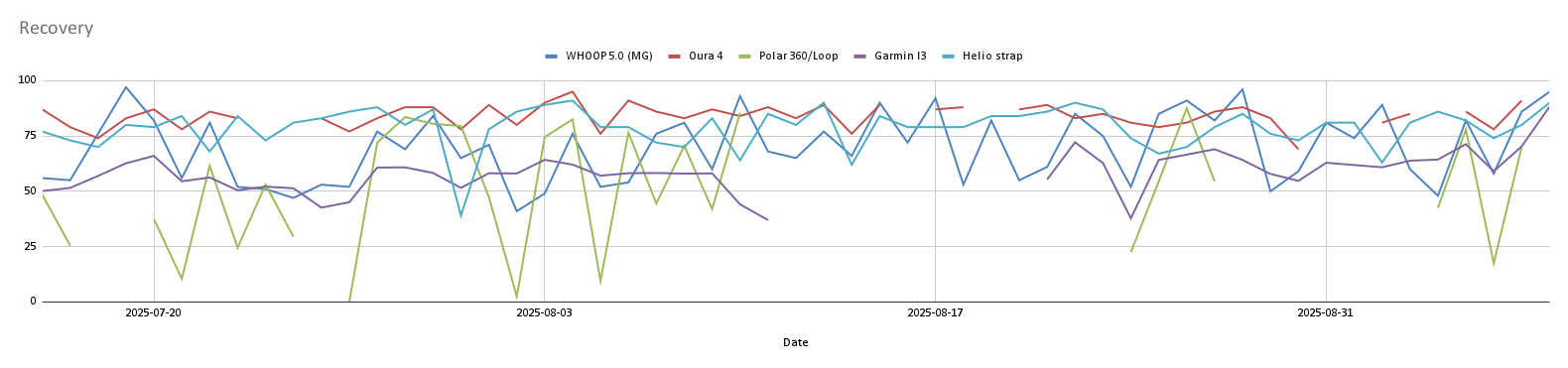
Recovery correlation

Sleep duration
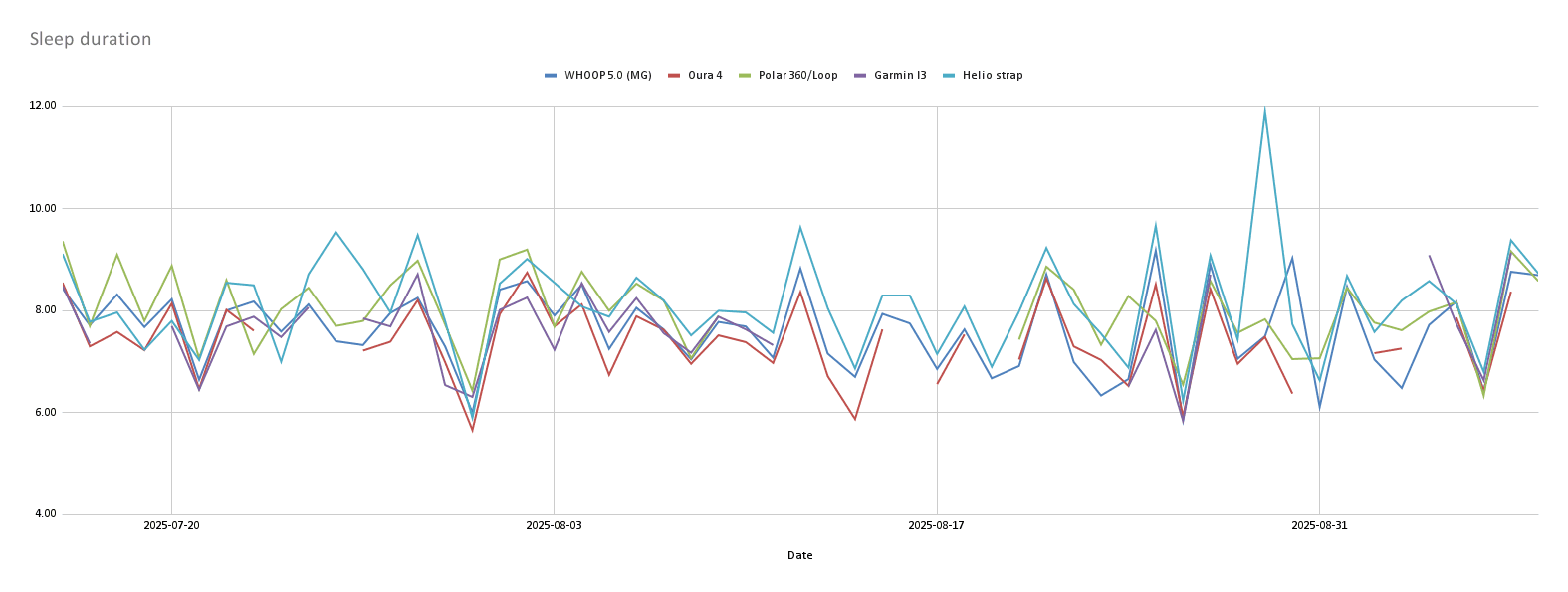
Sleep duration correlation

RHR
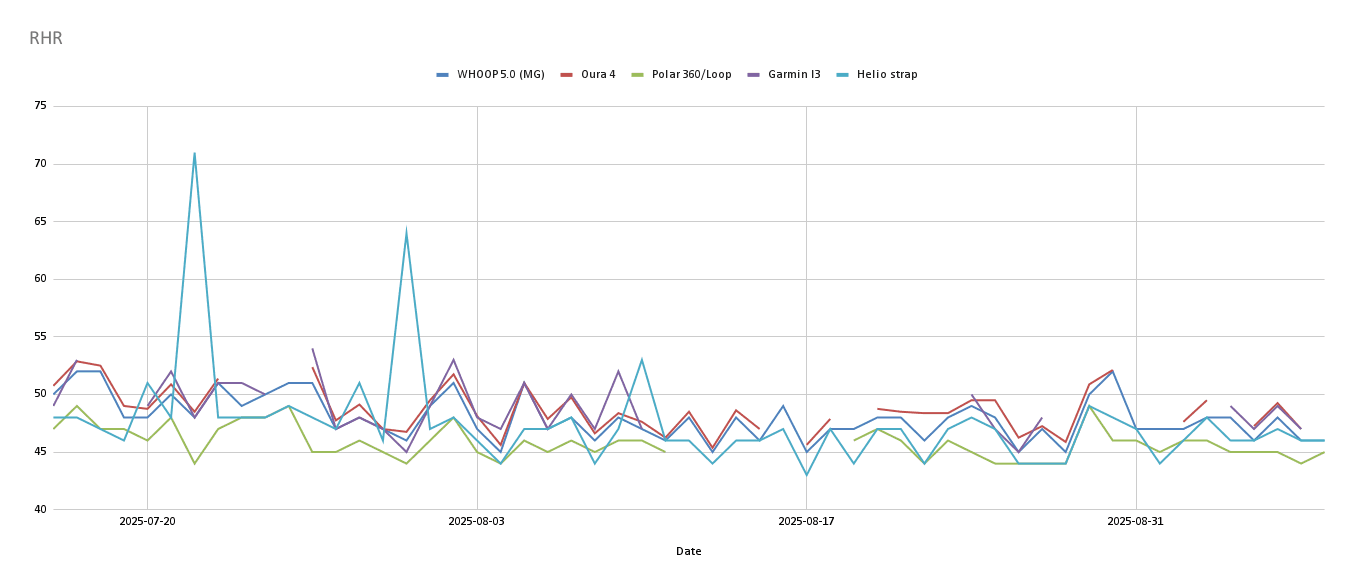
RHR correlation

HRV
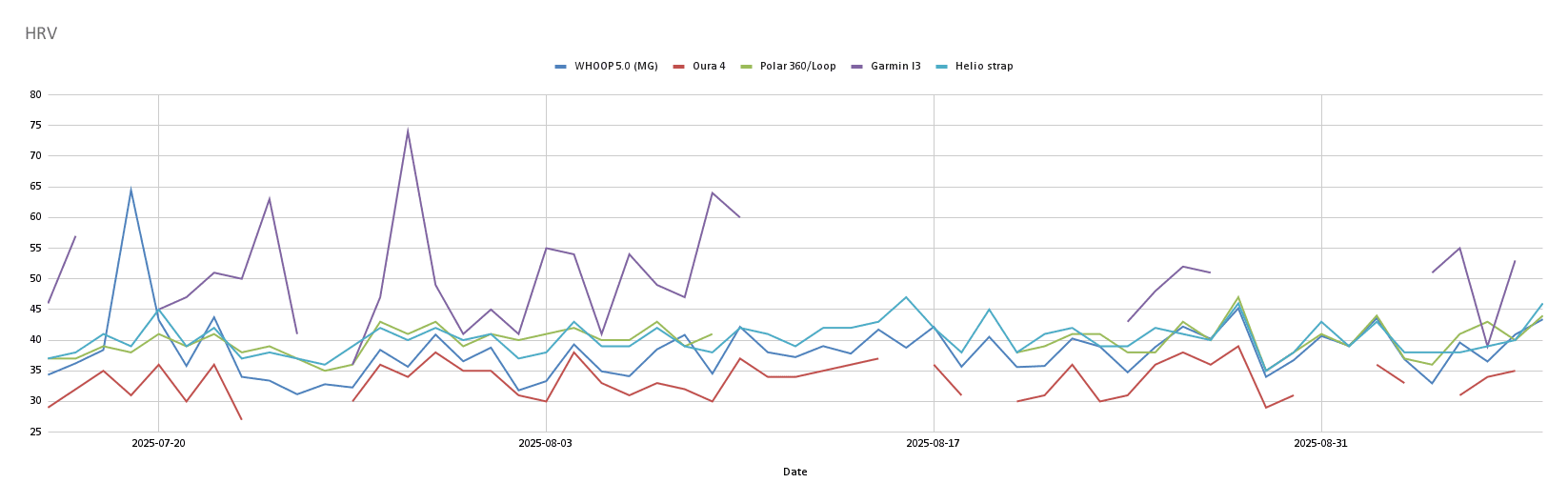
HRV correlation

How the metrics are calculated, and why the numbers differ
RHR
Devices do not define it the same way. While all measure throughout the sleep, the intervals vary. Polar looks at the first part of the sleep cycle, others throughout the night.
HRV
Most brands use RMSSD in milliseconds, but the collection windows and processing differ. All of them compute HRV during sleep, yet their windows and filtering are not identical.
What this means for comparison
The absolute numbers are naturally different across brands. I care about direction and trend more than raw levels, which is why I use Spearman rank correlations and why I treat recovery type scores as within brand trends.
Why I did it
This is part of my r/reThrive (check it out, it's cool I promise) side project that turns wearable data into your body age. If multiple devices tell similar stories, that builds trust. If they disagree, I want to know where and why.
What’s next
Half marathon in two weeks. In the meantime I ran another 10k and 14k with all devices, but the data crunching takes time. Helio is the slow part since the only way to get data out right now is paging through the app and typing numbers into a sheet.
What would you like to see next
Tell me what to compare or visualize.